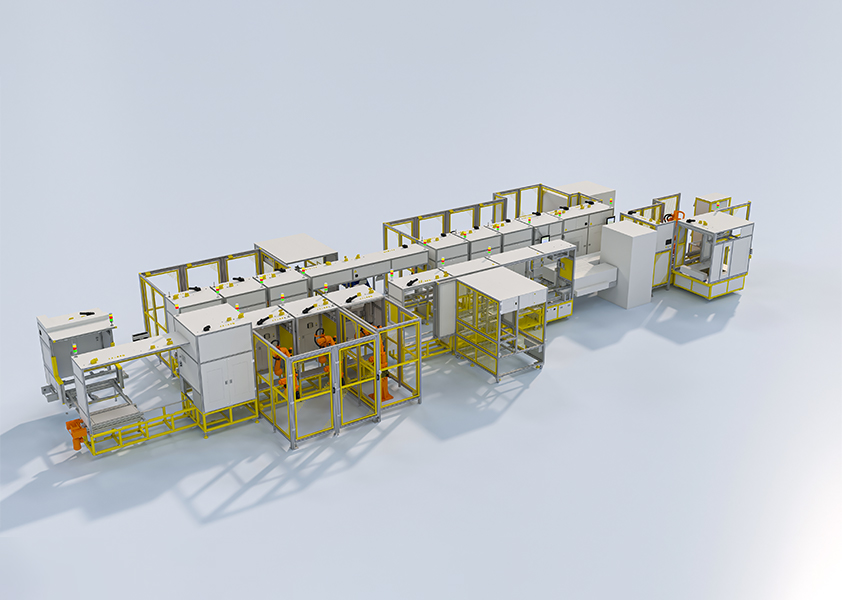
Opening assessment — the immediate problem to solve
Battery manufacturers confront a single, pressing problem: how to move from manual or semi-automated cells to reliable, repeatable automation without creating hidden quality or supply-chain failures. This task sits beside established manufacturing domains such as automotive automation, yet batteries bring distinct safety, traceability, and material-handling demands. Address these issues first; everything else follows from a clear statement of risk, capacity, and test requirements.

Top risks that must be closed before procurement
– Cell-to-cell variability that defeats inline controls and raises scrap rates. – Thermal and chemical safety exposures when handling electrolyte and active materials. – Supplier single points of failure for critical subsystems. – Unclear acceptance criteria between engineering and procurement. – Insufficient diagnostic data for predictive maintenance. Each risk must map to a measurable acceptance criterion before any purchase order is placed.
Core checklist: what to specify, verify, and accept
1) Requirements matrix: list functional, safety, throughput, traceability, and space constraints. Tie each requirement to a test procedure. 2) Process map: document each material flow and decision node from electrode receipt to finished module. Identify manual handoffs and failure modes. 3) Pilot scope: define a one-line pilot cell and a 30–60 day production acceptance window. Require rollback provisions. 4) Technology stack: specify robotics (payload, repeatability), vision (resolution, cycle-time), cell-handling fixtures, and MES/PLC interfaces. 5) Traceability: require UID/serialization and immutable batch records accessible via your ERP. 6) Safety: demand SIL or PL ratings appropriate to handling steps and explicit interlock test scripts. 7) Spare-parts and obsolescence: require guaranteed parts lists for 5–10 years and a parts-replacement SLA. 8) Data and connectivity: require time-series logging, timestamped alarms, and standard APIs for analytics. 9) Acceptance tests: FAT, SAT, production burn-in, and defect-rate thresholds defined in contract. 10) Training and turnover: supplier must provide train-the-trainer sessions and competency sign-offs for operators and maintainers.
Vendor evaluation — decisive criteria
– Demonstrated throughput on comparable cell formats. – Field service coverage and spare-parts logistics aligned to your plant location. – Proven safety record with documented incident investigations. – Open communications: time to respond, technical depth of answers, and willingness to run witness tests. Score vendors against these items and require references tied to verifiable plants. A useful real-world benchmark is Toyota’s production lines in Toyota City, Japan, where line-balancing discipline and supplier integration set clear expectations for handover and uptime.
Integration with production systems and common pitfalls
Integrate automation with MES, PLCs, and quality systems early. Avoid these mistakes: accepting black-box controls without APIs; deferring software validation until after mechanical commissioning; assuming laboratory-quality cells will behave identically on high-speed lines. When you design integration, include a staged deployment that allows fallback to manual modes with clear operational instructions.
Testing, KPIs and what to watch during commissioning
Essential KPIs: throughput (cells/hour), first-pass yield, mean time to repair (MTTR), mean time between failures (MTBF), and traceability completeness. During commissioning enforce: run-in of 72 hours at target throughput, repeatable defect detection rates below contract thresholds, and verified end-to-end UID tracking. Maintain a public log of deviations and corrective actions during SAT so procurement and engineering share accountability.
Procurement terms and contract language to insist on
– Explicit acceptance tests and scoring. – Warranty that covers process-critical parts and software defects for a minimum defined period. – Performance penalties tied to availability and yield guarantees. – Clear IP terms for data you generate on the line. – Maintenance and upgrade path with fixed pricing windows to avoid surprise costs.
Operational readiness and workforce considerations
Train operators on failure modes and quick isolation steps. Staff must be capable of running diagnostic scripts and interpreting logs. Create a certification checklist for operators and maintenance staff; require supplier-led shadow shifts until local staff can independently execute diagnostics and safe shutdowns.
Pitfalls that undermine long-term value
– Releasing payment before passing SAT. – Allowing undocumented custom PLC code to remain without version control. – Skipping burn-in under real materials and cycle rates. – Failing to require spare-part lead times in the contract. Address these now; later remediation costs far exceed initial diligence.

Quick reference: compact action list for the first 60 days
– Freeze requirements and acceptance tests. – Run vendor FATs with your QA and engineering present. – Pilot on one line, test with real materials. – Validate traceability and data export. – Certify operations and maintenance teams before any scale-up.
Closing guidance and expected outcome
Follow this checklist to reduce safety incidents, preserve product quality, and secure predictable production ramp. The steps above reflect field audits and project oversight work across battery and automotive projects, and they lead to clear handover criteria, operational competence, and contractual protections that protect your capital investment. Practical implementation of this approach aligns engineering, procurement, and operations around verifiable outcomes and supports sustained production performance through partners such as FHS.